Interview with Leilane Menezes Rodrigues
Virginia Bazán-Gil Reelected as FIAT/IFTA President
Joined by New Executive Council Members

Interview with Leilane Menezes Rodrigues

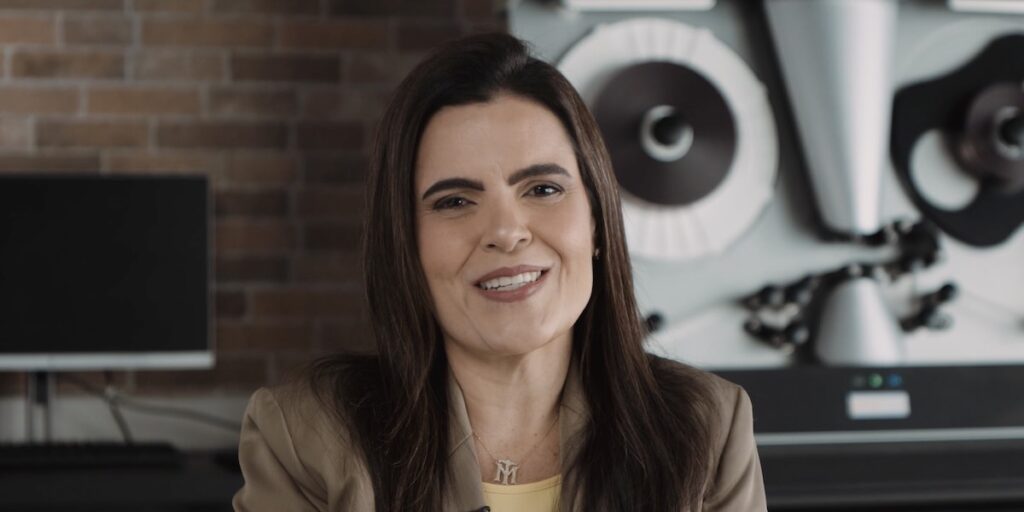
We present an exclusive interview with Dr. Leilane Menezes Rodrigues, recipient of the Media Studies Grant 2026. Her project, “Our TV, Our Memory: Recovering the Lost Archive of ‘TV da Gente’ and its Significance for Black Representation in Brazilian Media”, recovers and analyzes the history and material remnants of Brazil’s only Black-owned public television concession, which operated from 2005 to 2007.
In this interview, she discusses her motivations for pursuing this topic, the challenges of working with archival material, the broader impact of her findings, and more.
After nearly 20 years immersed in Brazilian media studies, I thought I had a firm grasp on the landscape – until my PhD research, about three years ago, introduced me to Dr. Tiago Vinicius André Dos Santos’s work, Desigualdade Racial e Midiática (Racial and Media Inequality). While mapping Black media across the 19th, 20th, and 21st centuries, I uncovered a staggering fact: Brazil has only ever had one public television station owned by a Black person, TV da Gente (2005-2007). The revelation felt absurd, yet heartbreakingly emblematic of the racial disparities ingrained in my home country. I became instantly committed to tracing this station’s history and, above all, finding its archive. But when I ran my first search, I found virtually nothing. How could the legacy of such a monumental project have simply evaporated from public memory? That question— and the silence surrounding the answer — has driven my research ever since
The biggest hurdle was simply locating the actual broadcast footage. While fragments exist across the internet, I was determined to reconstruct this archive in a meaningful way, not just settle for scattered clips. Considering the station aired daily content from 2005 to 2007, we’re talking about a staggering volume of lost history. It became a true detective mission. I reached out to everyone who had worked there, trying to pinpoint who held the original tapes. No one officially did. The only person who had kept a personal collection passed away years ago, leaving the fate of her materials completely unknown. At that point, I invited two documentary producers to join me in this archaeological dig. Together, we combed through digital remnants and struck gold when we identified the actual production company behind the shows. Though they had only a limited amount, they had posted significant samples on YouTube. Thanks to that discovery, we’ve now successfully recovered some footage from the vast majority of the programs.
I see archives as essential counterweights to a deeply rooted culture of erasure in Brazil. The country has long grappled with what I call a memory problem—a deliberate overlooking of its own past, most infamously symbolized by Rui Barbosa’s decree on May 13, 1891, when, as Minister of Finance, he ordered the burning of the nation’s slavery archives. That act was no accident; it was a foundational gesture of intentional forgetting, and its shadow looms large over Black media history. Archives are active sites of resistance. Recovering and contextualizing the surviving fragments of Brazil’s Black media memory, particularly within the broader framework of structural inequality, actively reconstructs a stolen past and offers a vital corrective to dominant historical narratives. This work is a crucial step toward preserving the very core of Brazilian identity itself.
We live in an age defined by the ephemeral. What we post today vanishes within twenty-four hours; we scroll endlessly through infinite feeds, jumping from one story to the next. Yet, to truly grasp enduring social struggles — such as the centuries-long fight of Black media for liberation and self-representation— we urgently need stable, lasting sources of memory. I hope that by reading about TV da Gente and watching the documentary, people will realize how much was lost and why it matters. Archives are that powerful thread, weaving together past and present.
First, that whiteness itself operates as a form of property, a key that historically unlocks access to broadcast concessions and public resources, which in turn generate generational wealth and, crucially, control over public representation. Owning a television station is not merely a business venture; it is a deeply embedded link in a historical chain of structural inequality that stretches back to the nation’s very foundations.
Second, TV da Gente stands as a rich and compelling counter-narrative — a living virtual quilombo, or digital maroon society, in action. Through the recovered footage and oral histories featured in our documentary, we catch a profound glimpse of what Black media can look like when given the conditions to speak for itself, beyond the limiting portrayals of violence often crafted for a white gaze.
Finally, this project reveals a dual urgency for all of us who safeguard moving images: how alarmingly fragile broadcast history can be, and how absolutely indispensable our collective effort is to actively resist that fragility.